
CHAPTER 1. THE LOCKED DOOR
Every house has its rules. In my grandmother’s house, there was only one.
Never go into the attic.
The attic door was at the top of a narrow staircase at the end of the upstairs hall. It was painted dark green, and it was always locked.
Every night at nine o’clock, Grandma Ivy climbed those stairs, checked the lock, and came back down.
She did it for as long as I could remember.
“What’s up there, Grandma?” I asked when I was eight.
“Dust and memories,” she said. “And neither one is good for little girls.”
I spent every summer at her farmhouse in the hills. My mother dropped me off in June and picked me up in August.
Grandma Ivy taught me how to bake bread, how to tell a robin from a wren, and how to sit on the porch in silence without feeling lonely.
But she never told me what was in the attic.
CHAPTER 2. THE WHISPERS IN TOWN
When I was twelve, a girl at the general store whispered something to her friend as I passed.
“That’s the granddaughter. Of the woman who killed her husband.”
I stopped cold.
I went home and asked my mother on the phone that night.
There was a long silence on the line.
“Your grandfather left when I was a baby, Lily,” Mom said finally. “That’s all. People in small towns like stories.”
“But where did he go?”
“Nobody knows. He just left.”
Her voice was tight. I didn’t ask again.
But I started watching that green door.
And I started noticing that Grandma always looked tired after her nine o’clock climb, as though she’d carried something heavy up those stairs and something heavier back down.
CHAPTER 3. THE FUNERAL
Grandma Ivy died in her sleep the winter I turned twenty-six.
She was ninety-one.
The funeral was small. The whole town came, but they stood at a distance, as if death and old rumors were catching.
My mother and I stayed at the farmhouse afterward to sort her things.
Mom couldn’t stop crying. She and Grandma had a complicated relationship. They loved each other but never seemed to know how to say it.
On the third day, the lawyer came by with Grandma’s will.
The farmhouse went to my mother. Her savings were split between us.
And there was one more item.
A small envelope addressed to me, in Grandma’s careful handwriting.
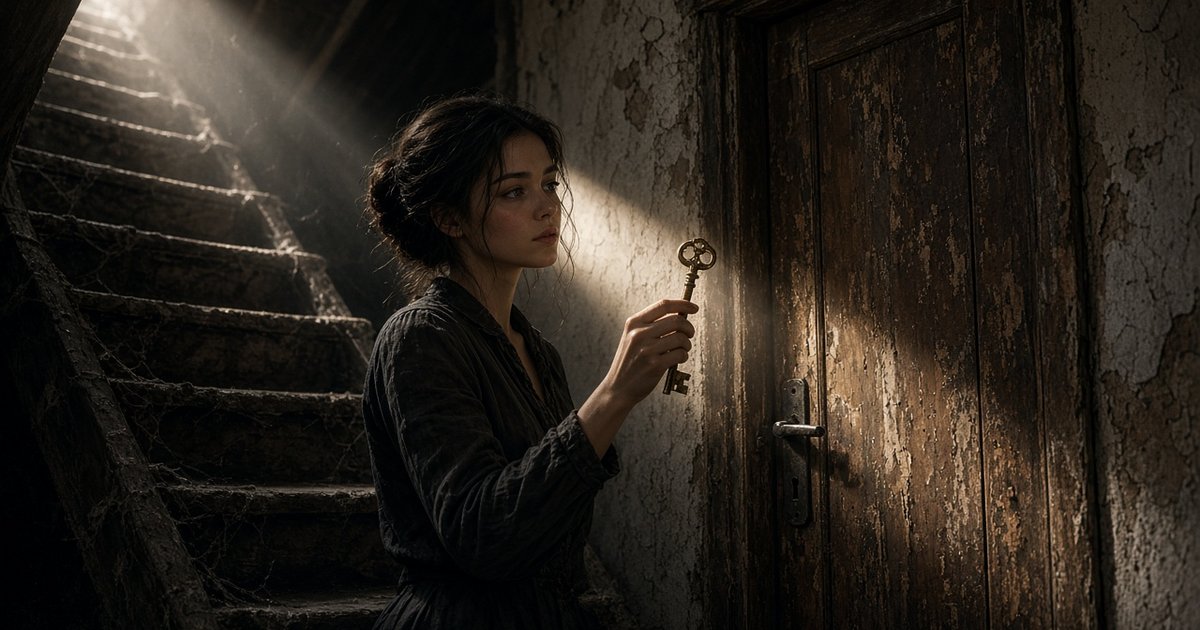
Inside was an old brass key.
And a note: “For Lily. When I’m gone. The attic. Read everything before you judge anyone.”
CHAPTER 4. THE ATTIC
I waited until my mother went to bed.
I don’t know why. Maybe I knew whatever was up there belonged to me first.
I climbed the narrow staircase with a flashlight. The steps creaked under my feet like they were complaining.
The key turned stiffly in the lock.
The green door swung open.
The attic was not full of dust. It was clean, almost carefully kept.
There was a small bed. A wooden rocking chair. A shelf of children’s books. A little table with a teacup.
And on the walls, dozens and dozens of photographs.
All of the same person.
A little boy.
CHAPTER 5. THE BOY
In the earliest photos, the boy was a baby in a christening gown.
Then a toddler holding a toy horse.
Then a little boy, maybe five, sitting on the porch of this very farmhouse.
The photos stopped there.
On the table, there was a stack of letters tied with a blue ribbon.
They were all addressed to the same name.
“My darling Samuel.”
I sat down in the rocking chair and began to read.
CHAPTER 6. THE LETTERS
The first letter was dated sixty-three years ago.
“My darling Samuel, today would have been your sixth birthday. I baked the lemon cake you liked. I set a place for you at the table. Your father says I must stop. I cannot stop.”
I read another.
“My darling Samuel, the river is high again this spring. I cannot look at it. I keep thinking if I had watched you more closely that afternoon, if I hadn’t gone inside for just two minutes…”
I covered my mouth with my hand.
Samuel had drowned. My grandmother’s first child. A son nobody had ever told me about.
I kept reading, letter after letter.
“Your father blames me. He says it is my fault. He drinks now. He is not the man I married.”
“Your father hit me again last night. I am expecting another baby. I am afraid.”
“Your sister was born today. I named her Rose. I will protect her the way I could not protect you.”
Rose. My mother.
CHAPTER 7. THE TRUTH ABOUT GRANDFATHER
The next letters were harder to read.
“My darling Samuel, last night your father came home drunk and raised his hand to little Rose. She is only eight months old. I picked up the fire poker. I told him to leave and never come back. I told him if he ever came near her again, I would go to the sheriff and tell them everything he has done. He took the truck and his money and left before dawn. I do not know where he went. I do not care. We are safe.”
And then, a later letter, dated three years after that.
“My darling Samuel, the town says I killed him. They say it because he vanished and because I never cried for him. Let them talk. If I tell the truth, Rose will grow up knowing her father was a monster. I would rather she believe he simply left. I would rather they believe I am a murderer than she believe she was unwanted.”
I sat in the rocking chair and wept.
For seventy years, my grandmother had let a whole town whisper about her.
To protect my mother from the truth.
CHAPTER 8. THE LAST LETTER
At the very bottom of the stack was a letter written recently, in shaky handwriting.
It was addressed to me.
“My dear Lily,
Now you know. I came up here every night to say goodnight to your Uncle Samuel. It was the only way I knew to keep loving him.
I never told your mother about her father’s cruelty. Maybe that was wrong. She grew up thinking she was abandoned, and she built walls because of it. I was so busy protecting her from the truth that I forgot to let her close.
You are the one who sat on the porch with me. You are the one who never needed me to explain myself.
Please, tell your mother everything. Tell her she was never unwanted. Tell her she was the reason I picked up that fire poker. Tell her she was the reason I survived.
And when you are done, open the window in the attic. Let the light in. I kept it closed far too long.
With all my love,
Grandma Ivy.”
CHAPTER 9. MY MOTHER
I went downstairs at dawn with the letters in my arms.
My mother was in the kitchen, making coffee in Grandma’s old percolator.
She saw my face and set the cup down.
“You went up there,” she said.
“She wanted me to. Mom, she wanted you to know.”
We sat at the kitchen table, and I read the letters to her one by one.
When I got to the part about the fire poker, my mother began to shake.
When I got to “Tell her she was never unwanted,” she broke down completely, sobbing into her hands like a little girl.
“I spent my whole life thinking he left because of me,” she whispered. “I spent my whole life angry at her for driving him away. And she was protecting me.”
“She loved you more than anything, Mom. She just didn’t know how to say it.”
CHAPTER 10. THE GRAVE BY THE RIVER
There was one more thing in the attic. A hand-drawn map, folded in the back of Samuel’s picture book.
It showed a small spot under a willow tree near the river, at the edge of the farm.
My mother and I walked there together that afternoon.
Under the willow, half hidden by moss, was a tiny stone.
“Samuel Ivy Whitfield. Our little light. Forever five.”
My grandmother had visited this place alone for seventy years.
My mother knelt down and cleared the moss away with her bare hands.
“Hello, big brother,” she said softly. “I’m sorry I never knew you.”
CHAPTER 11. LET THE LIGHT IN
The next week, my mother and I climbed the attic stairs together.
We opened the little window for the first time in decades. Sunlight poured in across the photographs, the rocking chair, the teacup.
We didn’t clear the room. We left it exactly as it was.
But we never locked the door again.
At the town’s spring festival that year, my mother stood up at the community meeting.
She told them the truth. About her father. About the fire poker. About a woman who let herself be called a murderer for seventy years to protect her child.
The room was silent when she finished.
Then an old man in the back, who had been a boy in town back then, stood up.
“My mother always said Ivy Whitfield was the bravest woman in this valley,” he said. “We just never knew why.”
Today, there’s a small bench beside the willow tree by the river.
A plaque on it reads: “For Ivy. Who carried the dark so her daughter could live in the light.”
THE END.
Read Next
 Nobody From My Office Came to My Father's Funeral. Only the Old Janitor Everyone Ignored Showed Up, and He Had a Secret
 My Stepmother Tore Up My College Acceptance Letter in Front of Me. She Had No Idea What My Late Mother Left Behind
 My Husband's Family Mocked My $18 Thrift Store Dress at a Wedding. Then the Bride's Wealthy Father Asked My Maiden Name