
CHAPTER 1. THE INVITATION
When the wedding invitation arrived, my husband’s mother called me before I had even opened it.
“Nora, I wanted to give you a little advice,” she said. “The Whitmores are a very important family. Please wear something appropriate.”
Appropriate. As if I might show up in a bathrobe.
My husband, Daniel, was the best man. His cousin Brooke was marrying into the Whitmore family, one of the wealthiest families in the city.
I had been married to Daniel for four years. In those four years, his family had never let me forget that I came from nothing.
I grew up in a trailer park outside a mill town. My father fixed tractors. My mother sewed curtains for other people’s houses.
Daniel’s mother, Patricia, liked to say I had “married up.”
She said it as a joke. Nobody laughed except her.
CHAPTER 2. THE DRESS
We didn’t have much money that spring.
Daniel’s hours had been cut at the firm, and I was still paying off my mother’s hospital bills from the year before.
I couldn’t afford a designer gown.
So I went to the thrift store on Maple Avenue, the same one my mother used to take me to.
In the back, on a crowded rack, I found it.
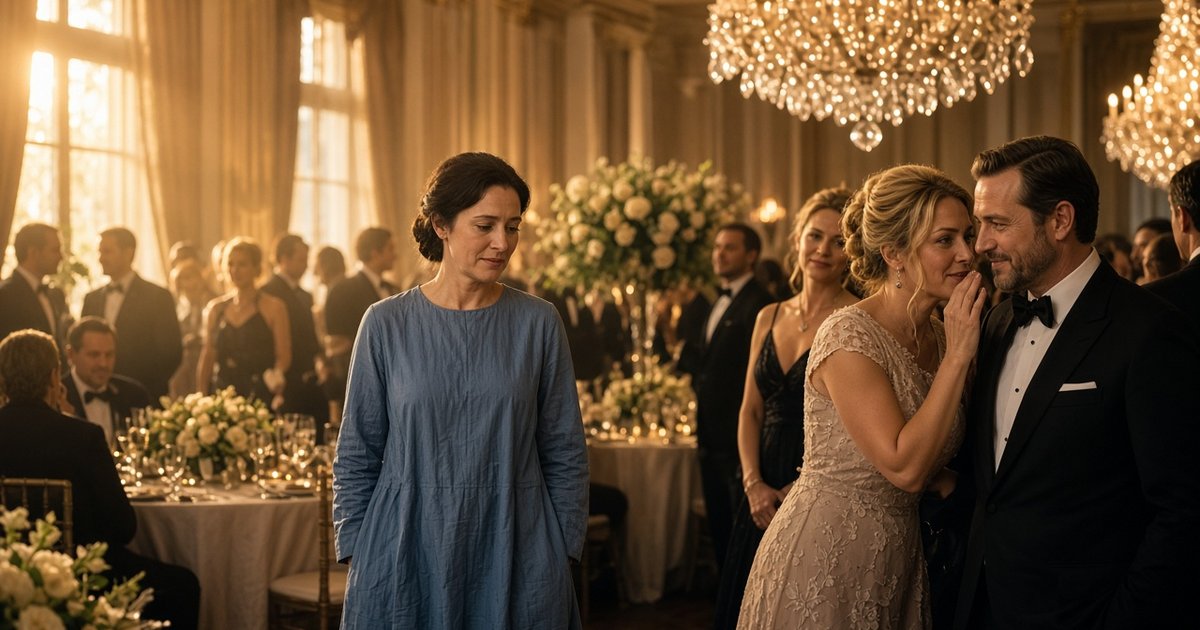
A long dress in faded blue silk. Simple. Elegant. Old-fashioned in the most beautiful way.
It cost eighteen dollars.
I took it home, and I fixed the hem with my mother’s old sewing kit. I replaced a missing button. I steamed it for an hour.
When I put it on, I felt like myself.
I stood in front of the cracked mirror in our hallway for a long time.
For a moment, I could almost hear my mother humming behind me, the way she did when she pinned a hem. “Stand still, baby. Beauty takes patience.”
She had been gone for a year, and I still reached for the phone to call her every Sunday.
Daniel smiled when he saw me. “You look beautiful.”
“Your mother is going to hate it,” I said.
He kissed my forehead. “My mother hates everything.”
CHAPTER 3. THE WHISPERS
The wedding was held in the grand ballroom of the Whitmore estate.
Crystal chandeliers. White roses everywhere. A string quartet in the corner.
The moment I walked in, I felt the eyes.
Patricia saw me from across the room and her face went pale.
She marched over and grabbed my elbow.
“What are you wearing?” she hissed.
“A dress,” I said.
“It looks like a costume from a museum. Everyone is staring. Did you buy that at a garage sale?”
“A thrift store, actually.”
She looked as if I’d slapped her.
Daniel’s sister, Melissa, came up behind her, holding a glass of champagne.
“Oh my God, Nora,” she said loudly. “Is that vintage or just old?”
A couple of guests laughed.
I could feel my cheeks burning. I wanted to disappear.
But I lifted my chin and walked to my seat.
My mother taught me that. “When people try to make you small, stand up straighter.”
CHAPTER 4. THE TOAST
Dinner was torture.
Patricia had arranged the seating so I was at the far end of the family table, next to an empty chair.
Daniel was at the head table with the wedding party. He kept looking over at me, worried.
Across the room, I heard Melissa telling a group of women, “She’s from some trailer park. Danny could have had anyone.”
I stared at my plate and counted my breaths.
Then the bride’s father stood up to give his toast.
Richard Whitmore was a tall man with silver hair and a deep, warm voice. He owned half the buildings downtown.
He spoke about his daughter, about love, about family.
Then, as he looked out over the room, his eyes stopped on me.
He paused mid-sentence.
Something changed in his face. He looked as if he’d seen a ghost.
He finished his toast quickly and sat down. But he kept looking at me.
CHAPTER 5. THE QUESTION
After dinner, the dancing began.
I was standing alone by the window when I felt someone beside me.
It was Richard Whitmore.
“Excuse me,” he said gently. “I’m sorry to bother you. But where did you get that dress?”
I braced myself for another insult.
“A thrift store,” I said. “On Maple Avenue.”
He nodded slowly. “May I ask your name? Your full name?”
“Nora Bennett. Well, Nora Kaye now. Bennett was my maiden name.”
He went very still.
“Was your mother Ellen Bennett? From Millbrook?”
My heart skipped. “Yes. How did you know?”
His eyes filled with tears.
“Because your mother made this dress,” he said. “Forty years ago. For my mother.”
CHAPTER 6. THE STORY
We sat down on a bench in the garden outside, away from the music.
Richard told me everything.
When he was a boy, his family wasn’t wealthy. They lived in Millbrook, same as mine. His father worked at the mill.
His mother, Anna, was dying of cancer, and she had one wish. She wanted to dance at her son’s high school graduation dance as a chaperone, in a beautiful dress, one last time.
They couldn’t afford one.
A young seamstress in town heard about it. She was barely nineteen.
She worked every night for two weeks and made this dress by hand, from silk she had saved for her own wedding.
She refused to take a single cent.
“Your mother gave my mother the happiest night of her last year,” Richard said. “Mom was buried in a different dress. We donated this one years later, when we moved. I never thought I’d see it again.”
He touched the hem gently.
“See this? A little rose stitched inside the seam. Your mother’s signature. She put it in everything she made.”
I lifted the hem and looked.
There it was. A tiny red rose.
I started crying right there in the Whitmore garden.
CHAPTER 7. THE PROMISE
“I tried to find her,” Richard said. “After I made my money. I went back to Millbrook. But she’d moved, and nobody knew where.”
“She married my father and moved to the trailer park two towns over,” I said. “She died last year.”
His face crumpled. “I’m so sorry. I wanted to thank her. I owe everything I’ve built to the lesson she taught me. That kindness doesn’t need a reason.”
He wiped his eyes.
“Did she have a good life?” he asked.
“She was poor,” I said. “But she was happy. She was the kindest person I ever knew.”
He nodded. “I believe that.”
CHAPTER 8. THE ANNOUNCEMENT
When we walked back into the ballroom, Richard asked the band to stop playing.
He took the microphone.
The room fell silent.
“I want to introduce someone,” he said. “This is Nora Kaye. Many of you noticed her dress tonight. Some of you, I’m told, laughed at it.”
I saw Patricia freeze. Melissa’s smile vanished.
“That dress was handmade forty years ago by Nora’s mother for my dying mother, for free, because she had a good heart. Without it, my mother would have died without one last night of joy.”
The room was so quiet I could hear the candles hiss.
“So tonight, I’m prouder of that dress than of anything in this room. Including the chandeliers I paid far too much for.”
A few people laughed softly.
“Nora, you are family to the Whitmores from this day forward.”
And then the room began to applaud.
CHAPTER 9. PATRICIA
Later that evening, Patricia found me near the coat room.
She looked uncomfortable, as if her expensive shoes suddenly hurt.
“Nora,” she said. “I didn’t know.”
“You didn’t need to know,” I said. “You just needed to be kind.”
She opened her mouth, then closed it.
“I’ve been unfair to you,” she said finally. “For four years. I thought where you came from mattered more than who you are.”
“It does matter,” I said. “It made me who I am. That’s why I’m not ashamed of it.”
She nodded slowly. It was the first real conversation we’d ever had.
CHAPTER 10. THE GIFT
A month after the wedding, a package arrived at our little apartment.
Inside was a framed photograph. A young woman with dark curls, holding a needle and thread, laughing. And next to her, a thin, pale woman in a blue silk dress.
My mother, at nineteen. And Anna Whitmore.
There was a note.
“Found this in my mother’s albums. It belongs with you. And there’s one more thing. The Whitmore Foundation is starting a sewing and design scholarship for young women from mill towns. We’d like to name it the Ellen Bennett Scholarship. With your permission. R.W.”
I sat on the kitchen floor and held that photo to my chest for a long, long time.
CHAPTER 11. WHAT REMAINS
The scholarship has helped fourteen girls so far.
Every year, I go to the ceremony in my mother’s blue dress.
Patricia comes too now. She sits in the front row and claps the loudest.
Last year, one of the scholarship girls asked me why I always wear the same old dress.
I showed her the little red rose stitched in the seam.
“Because the most valuable thing you’ll ever wear,” I told her, “is something made with love for someone who couldn’t pay you back.”
THE END.
Read Next
 A Little Girl Emptied Her Piggy Bank to Buy Bread for My Baby. Twenty Years Later, She Was Wheeled Into My ER
 My Sister Stole My Fiancé One Week Before Our Wedding. Five Years Later, She Called Me Crying at Midnight
 My Son Put Me in a Nursing Home So He Could Sell My House. He Never Bothered to Read the Deed