
CHAPTER 1. THE CHECKOUT LINE
It was the worst winter of my life.
I was twenty-three, a single mother with a six-month-old baby, and forty-one dollars to last until Friday.
My boyfriend had left when Noah was two weeks old. He said he “wasn’t ready.” Neither was I. But I didn’t get to leave.
That evening, I stood in line at the grocery store with formula, diapers, bread, and a bag of rice.
The cashier scanned everything.
“Fifty-three seventy,” she said.
I counted my money twice. Forty-one dollars and some change.
“Can you take off the bread?” I whispered. “And the rice?”
Behind me, a man in an expensive coat sighed loudly. “Some of us have places to be.”
A woman muttered, “If you can’t afford kids, don’t have them.”
I felt my face burn. Noah started to cry.
I was taking the bread out of the bag when a small voice said, “Wait.”
CHAPTER 2. THE PIGGY BANK
I turned around.
A little girl, maybe seven, stood beside her grandmother in the next aisle.
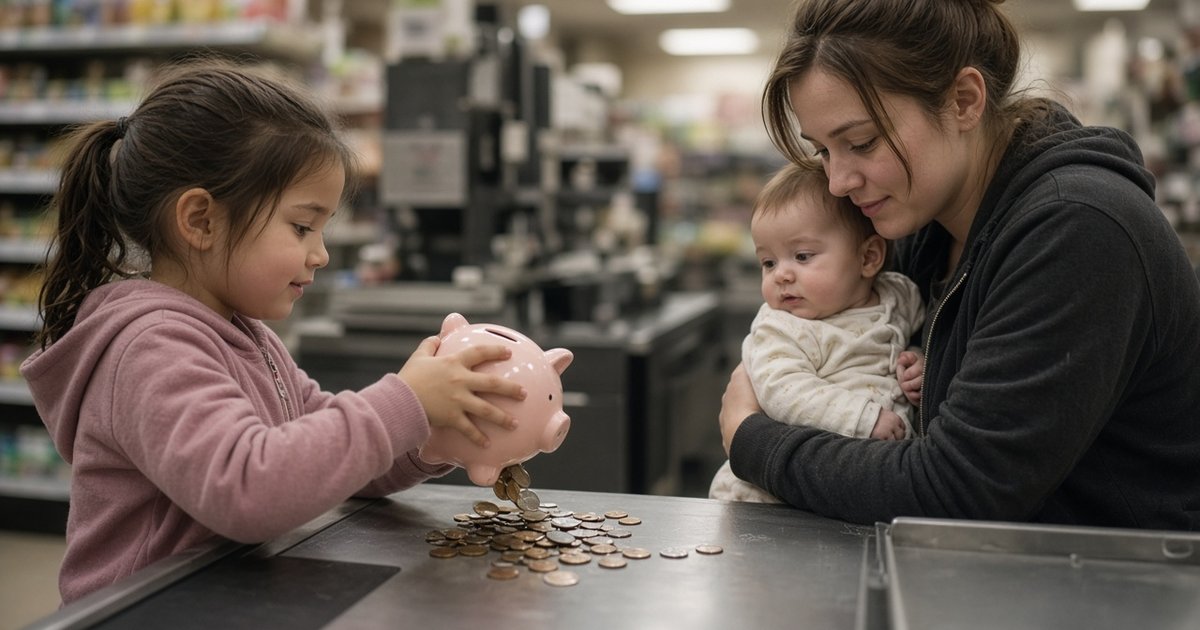
She had dark pigtails, a pink coat, and she was holding a pink plastic piggy bank in both arms.
“I was going to buy a toy pony,” she said seriously. “But your baby needs food more.”
Before anyone could stop her, she pulled the rubber plug from the bottom of the piggy bank and poured a pile of coins onto the counter.
Pennies. Nickels. Dimes. A few quarters.
The whole line went quiet.
The cashier counted it slowly. Eleven dollars and forty cents.
“That’s enough for the bread,” the cashier said softly. “And the rice.”
I started to cry. I couldn’t help it.
“What’s your name, sweetheart?” I asked.
“Hope,” she said. “Hope Delgado.”
Her grandmother squeezed her shoulder and smiled at me with tears in her eyes.
“Her mama passed last year,” the grandmother whispered. “She says she’s going to be kind like her mama was.”
CHAPTER 3. THE PROMISE
I knelt down in front of that little girl.
“Hope,” I said, “one day, I’m going to pay you back. I promise.”
She shook her head. “You don’t have to. Mama said when you help someone, you don’t keep score.”
Then her grandmother took her hand, and they walked out into the snow.
The man in the expensive coat didn’t say anything else. He just looked at the floor.
That night, I fed Noah and ate my first real dinner in three days.
And I wrote her name on the inside of my kitchen cupboard in pencil.
Hope Delgado.
So I would never forget.
CHAPTER 4. CLIMBING
The next years were hard, but I climbed.
I got a job cleaning offices at night. My neighbor, an old lady named Mrs. Kim, watched Noah for almost nothing.
I studied for my GED during my breaks.
I read textbooks in supply closets with a flashlight. I memorized vocabulary while mopping hallways. Some nights I fell asleep on the bus and woke up at the end of the line, miles from home, and had to walk back in the cold.
But I never missed a feeding, and I never missed a class.
Then I enrolled in community college. Then nursing school, on loans and scholarships and very little sleep.
Every time I wanted to quit, I opened that cupboard and looked at her name.
A seven-year-old had given up her pony for a stranger.
The least I could do was not give up on myself.
By the time Noah was ten, I was a registered nurse.
By the time he was fifteen, I was a nurse manager at the biggest hospital in the city.
I married a good man named Paul, a high school teacher who loved Noah like his own.
We bought a house. I took the pencil marks with me. I copied her name onto a card and kept it in my wallet.
CHAPTER 5. THE SEARCH
I tried to find her more than once.
But Delgado is a common name, and she was only a child. I had no address. I didn’t even know her grandmother’s name.
I checked social media. I asked around at that old grocery store, which had changed owners twice.
Nothing.
Paul told me once, “Maybe the way to pay her back is to be Hope for someone else.”
So I did.
Every Christmas, our family paid off strangers’ layaway accounts at the local store.
I started a small fund at the hospital for mothers who couldn’t afford formula when they went home with their babies.
We called it the Piggy Bank Fund.
Nobody knew why. Except me.
CHAPTER 6. TWENTY YEARS LATER
Twenty years after that night in the grocery store, I was working a late shift in the emergency department.
A young woman was brought in by ambulance. Car accident on the icy highway.
She was conscious, scared, and bleeding from a cut on her forehead. She kept asking about her daughter, who was in the car seat.
“Your daughter is fine,” I told her, holding her hand. “She’s in the next room with a nurse. Not a scratch.”
The woman cried with relief.
I looked at her chart to note her information.
Name: Hope Delgado-Ramirez. Age: 27.
My hand stopped moving.
CHAPTER 7. THE RECOGNITION
I looked at her face. The dark hair. The eyes.
“Hope,” I said slowly. “Did you grow up on the east side? Did you live with your grandmother?”
She looked at me, confused. “Yes. Why?”
“Did you once empty a pink piggy bank at a grocery store to buy bread for a crying lady with a baby?”
Her eyes went wide.
“How do you know that?”
I pulled out my wallet with shaking hands and showed her the card. Her name, written in my handwriting, worn soft from twenty years of being carried.
“I’m the lady with the baby,” I said.
She stared at the card. Then she started to cry, and so did I, right there in the emergency room, while the machines beeped around us.
CHAPTER 8. HOPE’S STORY
Over the next few days, while she recovered, Hope told me her story.
Her grandmother had passed away when she was sixteen. She bounced between relatives.
She married young. Her husband was a good man, a construction worker, but he was injured on a job site two years ago and couldn’t work.
She’d been working two jobs as a cashier.
“At a grocery store,” she said with a tired laugh. “Funny, right?”
They were behind on rent. Her car, now totaled, was the only way she got to work. They had no savings.
“I don’t know what we’re going to do,” she whispered.
I held her hand.
“You don’t have to know,” I said. “Not tonight.”
CHAPTER 9. KEEPING SCORE
That night, I went home and told Paul and Noah everything.
Noah, now twenty, a college student, listened in silence.
Then he said, “Mom, she bought my food. When I was a baby. That little girl fed me.”
“Yes,” I said.
He went to his room and came back with his laptop.
“How much does she need?”
Paul smiled at me across the table.
We didn’t keep score. But we kept a promise.
CHAPTER 10. THE SURPRISE
On the day Hope was discharged, Paul and Noah and I were waiting in the hospital lobby.
Her husband, Marco, was with her, pushing their little daughter in a stroller.
I handed Hope an envelope.
Inside was a letter, a set of car keys, and a receipt.
Our family had paid six months of their rent. Paul’s brother, who owned a car dealership, had sold us a reliable used minivan at cost. And the Piggy Bank Fund at the hospital had arranged for Marco to begin physical therapy with a specialist, free of charge.
Hope looked at the papers and couldn’t speak.
“I can’t accept this,” she finally said. “It’s too much.”
“Your mama said when you help someone, you don’t keep score,” I reminded her. “I didn’t keep score. I just kept your name.”
CHAPTER 11. THE PINK PIGGY BANK
A month later, I received a small package in the mail.
Inside was a pink plastic piggy bank, old and scratched, with a rubber plug in the bottom.
And a note.
“This is the same one. Grandma kept it. I want your Piggy Bank Fund to have it. Put it on the desk where mothers can see it. Maybe someone will be brave enough to ask for help.
And thank you, for remembering a little girl everybody forgot.
Love, Hope.”
That piggy bank sits on the front desk of our maternity ward now.
Next to it is a small sign that reads: “Need help? Ask. Someone once helped us.”
Every few weeks, I find a few coins inside it.
Pennies. Nickels. Sometimes a folded dollar bill.
I never know who leaves them.
But I always know where kindness comes from.
It comes from a seven-year-old in a pink coat who decided a stranger’s baby mattered more than a toy pony.
And it never, ever runs out.
THE END.
Read Next
 My Husband's Family Mocked My $18 Thrift Store Dress at a Wedding. Then the Bride's Wealthy Father Asked My Maiden Name
 My Rich Brother-in-Law Mocked My Husband for Being a Mechanic at Thanksgiving. A Month Later, His Porsche Died in a Blizzard
 My Mother-in-Law Served Me Cold Leftovers at Christmas While Everyone Ate Steak. Ten Years Later, She Knocked on My Door Begging for Help