
CHAPTER 1. THE PLATE ON THE SIDE
The first Christmas I spent with my husband’s family, I learned exactly where I stood.
It was a small white plate, set apart from the others.
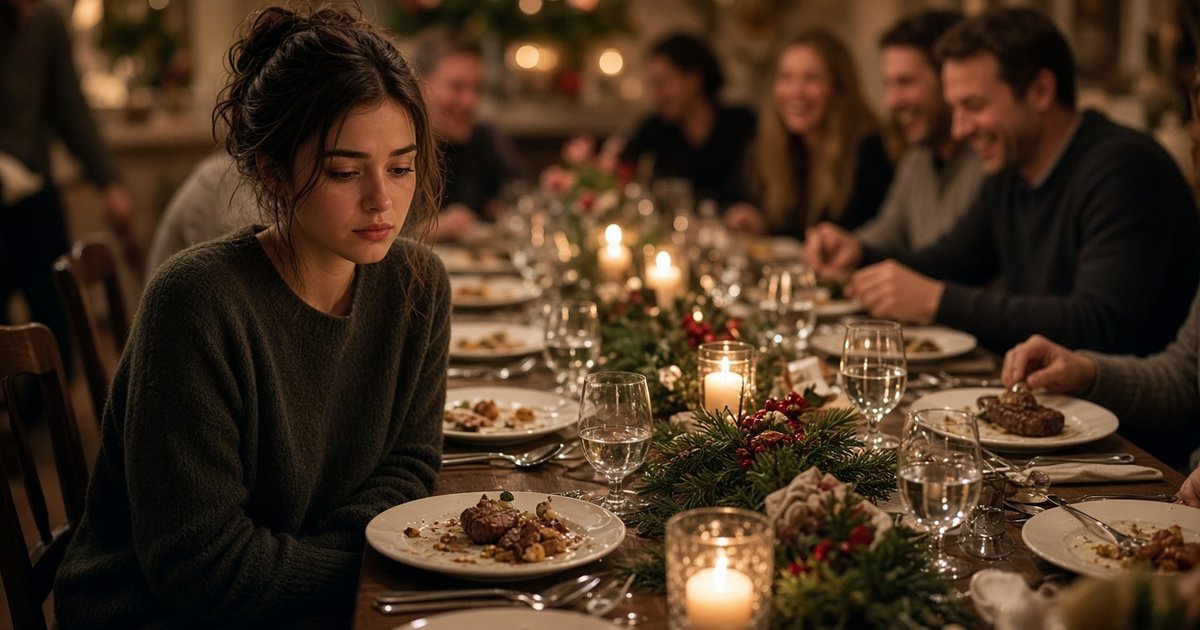
Everyone else had fine china with gold rims. Mine looked like it came from the back of a cupboard.
“Grace, sweetheart, I saved you something,” my mother-in-law, Diane, said with a smile that never reached her eyes.
On the plate was a spoonful of cold mashed potatoes, two slices of dry turkey from the day before, and a bread roll that was hard as a stone.
At the center of the table sat a platter of thick, perfectly cooked steaks.
There were exactly eleven of them.
There were twelve of us.
I looked at my husband, Michael. He was laughing at something his brother said. He didn’t notice.
Or maybe he chose not to.
“Oh, I must have miscounted,” Diane said loudly, so the whole table could hear. “But you don’t mind, do you, dear? You’re used to simpler food.”
Someone giggled. I think it was Michael’s sister, Vanessa.
I felt my face burn.
I grew up in a small apartment above a laundromat. My mother cleaned offices at night. We never had steak at Christmas.
But we never made anyone eat leftovers alone either.
“It’s fine,” I said quietly. “Thank you.”
And I ate every bite of that cold food while the people around me talked about ski trips and stock portfolios.
CHAPTER 2. THE YEARS OF SMALL CUTS
It didn’t stop with Christmas.
At Easter, Diane introduced me to her friends as “Michael’s little project.”
At Michael’s birthday, she handed me the apron before I had even taken off my coat.
“Grace is so good in the kitchen,” she told everyone. “It’s what she knows.”
When our daughter, Lily, was born, Diane held her for the first time and said, “Thank God she has Michael’s eyes.”
I cried in the hospital bathroom that night.
Michael found me there.
“She doesn’t mean anything by it,” he said. “That’s just how Mom is.”
“She means everything by it,” I whispered.
He sighed, the way people sigh when they want a conversation to be over.
I loved my husband. I truly did.
But I learned that loving someone doesn’t mean they will stand in front of you when the arrows fly.
So I learned to stand alone.
I took night classes in accounting while Lily slept.
I worked part-time at a small bakery on Fourth Street owned by an old widow named Mrs. Ruth Callahan.
Mrs. Callahan was everything Diane was not.
She was kind. She was blunt. She paid me on time and asked about my daughter by name.
“You’ve got a head for numbers and a heart for people,” she told me one morning while we rolled dough. “That’s rare, Grace. Don’t let anybody tell you you’re small.”
I didn’t know then how much those words would matter.
CHAPTER 3. THE BAKERY
Three years later, Mrs. Callahan’s health began to fail.
She had no children. Her husband had died long ago.
One afternoon she called me into the tiny office in the back.
“I want you to take over the bakery,” she said.
I laughed. I thought she was joking.
“I can’t afford a bakery, Mrs. Callahan.”
“I’m not asking you to buy it. I’m asking you to run it. Pay me a little each month while I’m alive. When I’m gone, it’s yours.”
I sat there with flour on my hands and tears in my eyes.
When I told Michael’s family at Sunday dinner, Diane laughed so hard she had to put her fork down.
“A bakery,” she said. “How fitting. You’ll be wearing a hairnet for the rest of your life.”
Vanessa smirked. “Do they give you a name tag?”
Michael said nothing.
That night, I asked him why.
“Grace, you know how she is. Why poke the bear?”
“Because I’m your wife,” I said. “And she’s been poking me for six years.”
He turned over and went to sleep.
CHAPTER 4. THE DIVORCE
Mrs. Callahan passed away the following spring.
She left me the bakery, the building it sat in, and a short handwritten note.
“Grow something, Grace. And never eat at a table where you have to beg for a seat.”
I read that note a hundred times.
Six months later, I found the messages on Michael’s phone.
They weren’t from another woman.
They were from his mother.
“She’s dragging you down. You could do so much better. Leave before she gets anything.”
And his reply.
“I know, Mom. I’m working on it.”
I didn’t scream. I didn’t throw things.
I simply put the phone down on the kitchen table, took Lily’s hand, and went to stay in the small apartment above the bakery.
The divorce was quick.
Michael’s lawyer, paid for by Diane, made sure I left with very little.
But the bakery was mine. It had been left to me, not to us.
That was the one thing they could not take.
CHAPTER 5. TEN YEARS OF FLOUR
I won’t pretend those years were easy.
I woke at three in the morning. I baked until noon. I did the books until Lily came home from school.
I burned my arms on oven racks. I cried over broken mixers and late rent from the upstairs tenant.
But slowly, the bakery grew.
A food writer wrote about our cinnamon bread. Then a local TV station came.
I opened a second location. Then a third.
By the tenth year, “Callahan’s” had seven bakeries across the state and a contract with two grocery chains.
I named it after the woman who believed in me.
Lily grew up in the smell of warm bread. She was smart and fierce and kind.
She saw her father on weekends. She rarely saw her grandmother.
“Grandma Diane looks at me like I’m a stain,” she told me once, at twelve years old.
I hugged her and said nothing. Some lessons a child learns on her own.
CHAPTER 6. THE KNOCK
It was a cold Tuesday night in December when someone knocked on my door.
I opened it, expecting a neighbor.
Instead, Diane stood on my porch.
She looked smaller than I remembered.
Her expensive coat was old now. Her hair, once perfectly colored, was gray at the roots.
“Grace,” she said. “May I come in?”
For a moment, I thought about closing the door.
Then I remembered Mrs. Callahan’s kitchen, and how she had never turned away anyone who was hungry.
“Come in,” I said.
She sat at my kitchen table and wrapped her hands around a cup of tea.
“I don’t know how to say this,” she began.
It turned out her husband had made terrible investments before he died. The house was gone. The savings were gone.
Vanessa had married and moved overseas and no longer answered her calls.
And Michael?
“Michael lost his job last year,” she said quietly. “He’s been sleeping on a friend’s couch. He’s too proud to ask you for anything.”
“And you’re not?” I asked.
She looked at her tea for a long time.
“I am,” she said finally. “But I’m more hungry than proud.”
CHAPTER 7. THE TABLE
I could have said so many things.
I could have reminded her of the cold plate.
Of “Michael’s little project.”
Of the messages on his phone.
I could have shut the door and told her this was what she deserved.
Instead, I stood up and opened the refrigerator.
I took out a steak I had bought for the weekend, and I cooked it for her.
I set it on my best plate. The one with the gold rim.
She stared at it.
Then she started to cry.
“Why?” she whispered. “After everything I did to you?”
I sat down across from her.
“Because ten years ago, I promised myself that nobody would ever eat alone at my table. Not even you.”
She covered her face with her hands.
“I was so cruel to you,” she said. “I thought you were beneath us. I thought money made us better. And now I have nothing, and you’re the only one who opened the door.”
CHAPTER 8. WHAT I OFFERED
I didn’t give her money.
I gave her a job.
The front counter at our original bakery on Fourth Street needed someone in the mornings.
“You’ll start at six,” I said. “You’ll wear an apron and a name tag. And a hairnet.”
She flinched at that word. I watched her remember saying it to me.
Then she nodded.
“Thank you,” she said. “I’ll be there.”
She was.
Every morning for the next two years, Diane stood behind that counter and smiled at customers, real smiles this time.
She learned the regulars’ names. She learned to box pastries and make change.
One day, I saw her give a free roll to a little boy whose mother was counting coins.
She caught me watching.
“Somebody taught me that,” she said.
CHAPTER 9. MICHAEL
Michael came to the bakery once, a few months after his mother started.
He stood in the doorway in a wrinkled jacket and looked at the line of customers, at the shining glass cases, at the sign above the counter with Mrs. Callahan’s name.
“You did all this,” he said.
“I did.”
“I should have stood up for you,” he said. “Every single time. I didn’t. I’m sorry, Grace.”
I believed him. That was the strange part.
“I forgive you,” I told him. “But forgiving you doesn’t mean going back.”
He nodded slowly. “I know.”
I helped him find a job with one of our suppliers. He’s doing well now. He sees Lily every week, and he’s a better father than he ever was a husband.
Sometimes that’s the most you can hope for.
CHAPTER 10. THE LAST CHRISTMAS DINNER
Last Christmas, I hosted dinner at my house.
Lily set the table. Twelve plates. All the same. All with gold rims.
Diane came early to help in the kitchen.
When we sat down, she stood up and tapped her glass.
“I want to say something,” she said, and her voice shook.
“Years ago, I gave this woman a plate of leftovers on Christmas and laughed while she ate it. I was proud of that. God forgive me, I was proud.”
The room went silent.
“She had every reason to let me starve. Instead, she fed me. She gave me work. She gave me back my dignity, which is more than I ever gave her.”
She looked at me with wet eyes.
“Grace, you were never beneath us. We were beneath you.”
I didn’t know what to say. So I just reached out and squeezed her hand.
Lily leaned over and whispered, “Mom, that was the best Christmas present ever.”
She was right.
Because revenge would have filled one night.
Kindness filled every plate at that table, for years to come.
THE END.
Read Next
 My Stepmother Tore Up My College Acceptance Letter in Front of Me. She Had No Idea What My Late Mother Left Behind
 Nobody From My Office Came to My Father's Funeral. Only the Old Janitor Everyone Ignored Showed Up, and He Had a Secret
 My Sister Stole My Fiancé One Week Before Our Wedding. Five Years Later, She Called Me Crying at Midnight